Introducing Landing Page Spy
— the tool that reverse-engineers your competitors' paid advertising strategy by finding every landing page they're running, ranked by how confident we are it's a real ad destination.
What is Landing Page Spy?
When a competitor runs a Google Ads or Facebook campaign, they send traffic to dedicated landing pages — pages that are often hidden from their main navigation, excluded from search engines, and impossible to find by browsing their site. Landing Page Spy crawls their entire website and uses a multi-signal detection engine to surface those hidden pages, so you can see exactly what offers, funnels and messaging they're using to convert paid traffic.
How does it work?
Enter any competitor's domain and choose your detection methods. Landing Page Spy will crawl up to 2,000 pages and analyse each one against over 100 signals across five detection categories. Every page that matches is scored and ranked — the higher the score, the more confident we are that it's a dedicated landing page rather than a regular site page.
Detection Methods
You can run any combination of the five detection methods simultaneously. Each one catches landing pages the others might miss.
🎯 JavaScript Conversion Tracking
The most reliable signal of all. If a page has a conversion event firing, it's almost certainly a paid ad destination. Landing Page Spy scans every page's source code for active conversion tracking across all major ad platforms — including Meta/Facebook Pixel Purchase, Lead, Subscribe and Checkout events; Google Ads conversion tags; Bing Universal Event Tracking (UET) tags and conversion events; TikTok Pixel IDs and conversion events including Purchase, Lead, SubmitForm and CompleteRegistration; and Reddit Ads Pixel conversion events. Finding an active conversion tag on a page is one of the strongest possible indicators that real ad spend is being directed there.
🔗 URL Pattern Recognition
Marketers follow predictable conventions when naming landing pages. Landing Page Spy checks every crawled URL against a library of high-confidence path patterns including /lp/, /landing/, /ppc/, /sem/, /cpc/, /paid/, /post-click/, and dedicated subdomains like lp.domain.com and landing.domain.com. It also detects UTM parameters baked into internal links — utm_medium=cpc, utm_medium=ppc, utm_source=google and others — which confirm a page is part of a paid traffic workflow.
🏗️ Landing Page Builder Detection
Many businesses build their landing pages on dedicated platforms rather than their main CMS. Landing Page Spy fingerprints the most popular builders and platforms including Unbounce, Instapage, Leadpages, ClickFunnels, Kartra, ConvertFlow, Landingi, Swipe Pages and Wishpond. If a competitor is using any of these, you'll know — and you'll know exactly which pages they built on them.
📄 HTML Structural Signals
Beyond tracking code and URLs, Landing Page Spy reads the page's HTML for telltale structural patterns. It looks for noindex meta tags (landing pages are routinely hidden from Google), CSS class names and HTML attributes like data-page-type="landing", data-page="lp" and data-funnel, developer comments referencing landing pages, and dozens of naming conventions like landing-page, landing_page, landingPage, post-click, lead-capture and squeeze-page embedded in the source code. These signals catch landing pages that have been deliberately obfuscated or built on custom platforms.
🗺️ Sitemap Orphan Detection
Some of the most valuable competitive intelligence is hiding in plain sight. Landing Page Spy fetches your competitor's XML sitemaps — both from robots.txt and common guessed locations — and cross-references every URL against what was actually reachable during the crawl. Any URL that exists in the sitemap but wasn't crawlable is flagged as a potential orphan landing page — a page that's been deliberately excluded from internal linking so it can only be reached via a direct ad click.
🗄️ Landing Page URL Database
Landing Page Spy maintains a database of over 1,000 common landing page URL slugs built from real-world patterns — covering numbered variants (/lp-1 through /lp-20), alphabetical variants, seasonal paths (black-friday-landing, summer-sale-lp), geographic variants (lp-london, landing-page-uk), traffic source paths (lp-google, campaign-facebook), A/B testing slugs (lp-variant-a, lp-control, ab-test-1), audience segments (lp-b2b, lp-enterprise), funnel stages and hundreds more. Each of these is silently probed against the target domain and any that return a 200 response are analysed for further signals.
Confidence Scoring
Every detected signal contributes points to a page's total score. High-value signals like an active conversion tag or an explicit landing page builder fingerprint score 8–10 points each. Weaker structural signals score 5–8. Pages are then classified into five confidence tiers: Almost Certainly a Landing Page (score 40+), Very Likely (25+), Likely (15+), Possibly (5+) and Low Confidence. A smart penalty system automatically deducts points from pages whose URLs match known non-landing-page patterns — blog posts, news articles, author archives, category pages, FAQs, support docs and more — dramatically reducing false positives without you having to manually filter results.
Results & Export
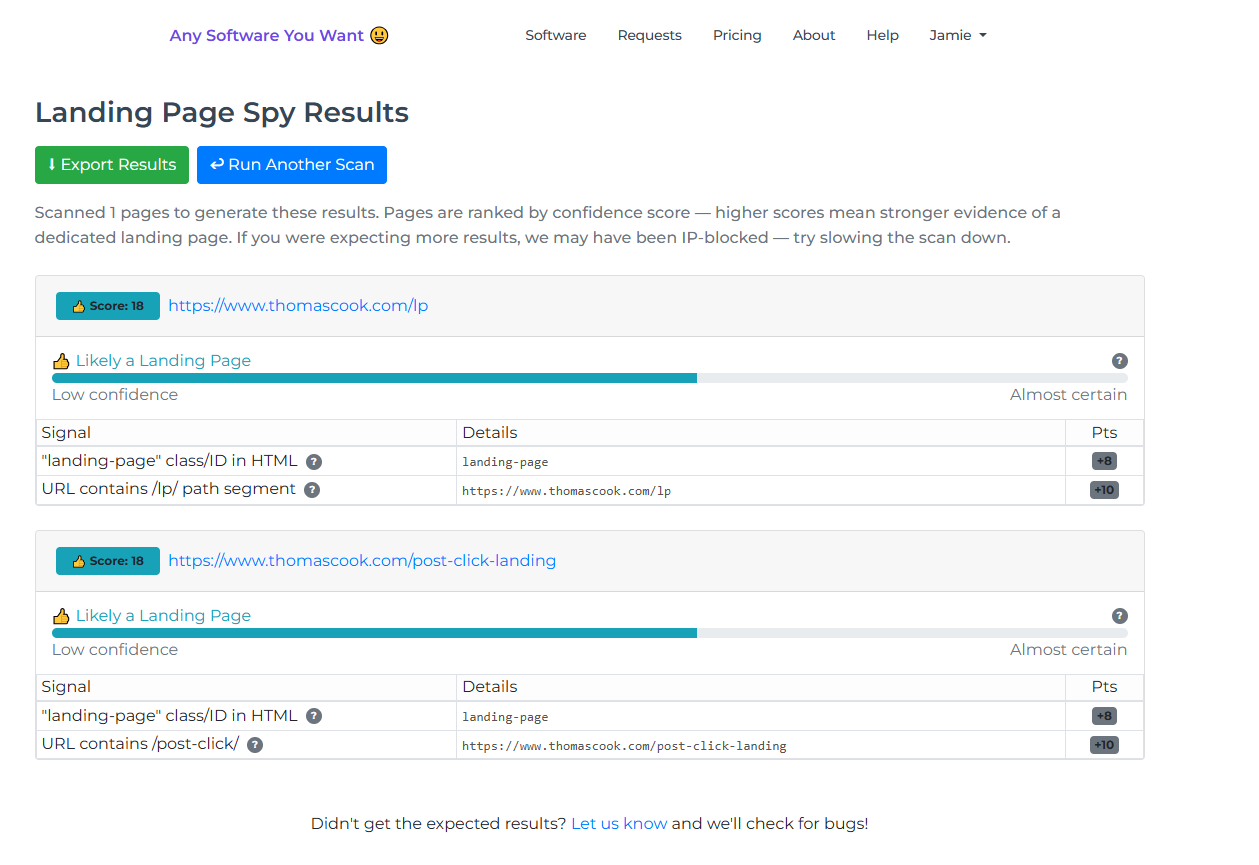
Results are presented as a ranked list of pages, sorted by confidence score. Each page shows a visual likelihood meter, every signal that fired with a plain-English explanation of what it means, and the raw evidence found in the page source. A tooltip on every signal explains exactly why it's significant. When you're ready to dig deeper or share your findings, export the full results to CSV in one click.
Who is it for?
Landing Page Spy is built for PPC managers who want to understand exactly what landing pages their competitors are split-testing; SEO and growth teams researching competitor conversion strategies; digital marketing agencies conducting competitive audits for clients; and anyone running paid advertising who wants to benchmark their landing page approach against the best in their industry. If your competitors are spending money on ads, they're building landing pages — and Landing Page Spy will find them.
Hello everyone, it's Jamie from NaSoftwareU1.com. I have over 60 tools to help you grow your
online business and in this video I will be showing you a demo of my tool called Landing
Page Spy. So before we begin I'll give you a brief overview of the tool and why, how
you might want to use it. So often you'll want to see your competitor's paid traffic
strategy. If you know what they're doing you can gain insights for that for your own
business and they'll help you come up with ideas for your own ad campaigns etc. So there's
a lot of tools out there that will show you your competitor's ads but they often don't
show you where those ads are going to as in their landing pages and they often miss out
ads and they often take a long time to show new ads because they have to query for example
Bing's ad API, it's set intervals because of rate limits and stuff. They have to scrape
ad libraries which isn't ideal because some regions don't have ads but others do because
of certain laws or they just have to search Google for certain keywords and then hopefully
your competitor's ads come up for those keywords and then scrape those ads. So they're very
good but they don't cover everything. So this tool is designed to be used in addition to
those tools and this tool will scan your competitor's website for landing pages. So places where
they're sending their paid traffic to, so when someone clicks on an ad they land on a
certain page called a landing page. So we take their home page, we load that page, we grab
all the internal links from it, we follow all of those pages and we keep doing that until
we either hit the crawl limit which is about 3,000 pages per website or we finished scanning
their entire website and every time we load a page we check for anything to signal that
it is a landing page. So that's an increased amount of call to actions like get a quote,
book an appointment, whatever. Certain segments in the URL that say landing page or PPC etc.
and then we check for things in the HTML and JavaScript such as conversion tags and tracking
pixels etc. And we also try to locate your competitor's site map as well. So we'll try
and extract their location from robots.txt or we will also just try and guess it from
a series of really common site map locations. And the reason we try and get the site map
is because often paid traffic landing pages you can't discover them often by crawling
a website because there's no internal links to them because they're not designed for users
to just hit organically but often as part of a CMS they will be included in the site
map. And being able to see your competitor's landing page is a really powerful competitive
edge to have because you can use a certain tool for finding the ads but then if you have
another tool for finding the landing pages you can see how they're trying to convert
the users once they've paid to get them on the site and that's just as important as
seeing the actual ads that they're running. You know you'll be able to see if you find
the landing page you can see what CTAs are they using to convert the users, what sort
of social proof and reviews etc. It's a really really useful thing to know. And also if you
know where their landing pages are you can often find the landing page before they even
start running ads because they've got to publish the landing page first before running the
ads right. So now we've covered what the tool is and how it works let's do a quick demo
of it. So for this quick demo we're going to use a website called Admiral so that's
a really popular insurance company in the UK their big name I've purchased insurance
through them before they're actually quite good and so we simply enter the domain up
there and then we've got some settings here because once you know where a website's landing
pages are you might want to exclude some of these to make it go faster so we'll just run
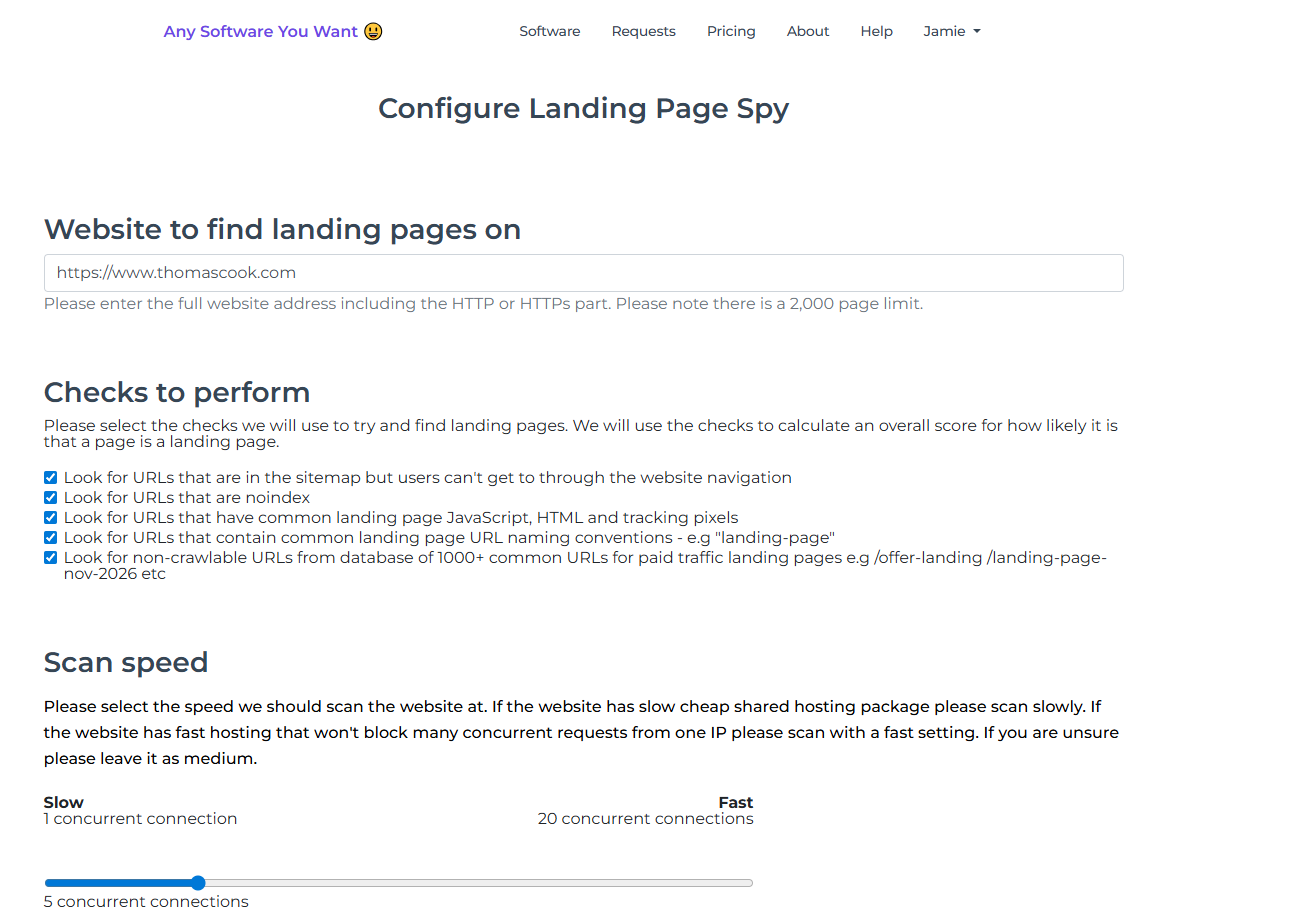
through these quickly. So look for URLs that are in the site map the users can't get to
through the website navigation so that's a possible flag that it could be a landing page.
Look for URLs that are no index typically if you're sending paid traffic to a landing
page you'll no index it because you don't want people landing on that page through organic
search because it's going to skew your stats for the page and how you're monitoring what
users do once they get on the page. Next look for URLs that have common landing page HTML
and tracking pixels so we'll look for things like tiktok pixels and reddit add pixels and
you know lead conversion stuff things like that. We'll look for URLs that contain common
segments that you'd find in a landing page URL such as landing page or l-p or lp slash things
like that and then as well as crawling the website and crawling the links in the site map
this last setting here will also try and load a database of it's about 1100 common URLs that
use for paid traffic so things like slash landing offers slash ppc dash add words etc
we'll just try and guess where those landing pages might be for paid traffic we'll use a big
database of URLs for that and then the final setting here is just how quickly you want to
scan your competitors website so obviously if you scan it too fast they might block the IP
address that we're scanning from and also it's just a nice thing to do not to scan it too fast
so typically five is okay if you run it at five and you don't get many pages crawled then just
crank it down to one and let it go really slowly so we've got all our settings we'll hit start
and we'll get some feedback now about what tool's doing you can see it's found some site maps
it's starting to crawl its way around the internal navigation of the website so we'll come back in a
few minutes when it's worked its way through all of the crawlable URLs it's worked its way through
all the site map URLs and it's around this database of common 1000 plus URLs that you would use for
paid traffic so we've come back a few minutes later and we've got the results of our scan here
so you can see we've found several pages that are clearly PPC landing pages so we've got all
the signals here and a confidence rating here now it's worth pointing out that
landing pages they don't have a set flag that says this is definitely a landing page and this one's
definitely not so we have to do some guesswork but we can get it relatively accurate by looking at
things you would typically expect from a landing page so let's look at this first one here so
you can see we found it from passing the site map so we didn't find it in the website's main
navigation and by the way if you want to know more you can just hover over this question mark
so this one here we found it in the site map that we didn't find it when we were crawling the website
it's about a small indication that it's a landing page it's got a no index tag so
admiral telling google and other search engines not to index it so again that's a small indication
that it's probably a landing page and then here the URL contains PPC so that's a stronger
indication that it's probably you know a pay per click landing page and then here if you
are nav links and home page so typically when you're driving pay traffic to a landing page you
often take away a lot of the navigation links because you've paid for that user to be there
you don't want them to land on the page you then think oh i wonder what this link goes to up here
and you know they'll click that and then they might not like what they see on the next page
and then you've lost that person that you've paid for so companies often strip away a lot of the
navigation links and what we do here is we compare the amount of links on the pages we're
crawling with the amount of links on the home page and you can see this page we crawled here
that's 36 and the main home page for the website has 113 and then the final indication this is
probably a paid landing page is that it's got more call to actions than the home page so when we
start crawling the website we check the amount call to actions um on the home page so we just
look for text values such as get a quote now or book an appointment now start today free sign up
common call to action text like that and then we compare it with every other page that we crawl
and you can see we didn't find any common call to actions on the home page but we did find three
on this page which is another signal it's probably a landing page and they're trying to get the user
to convert into the lead with these common call to actions and if we open this website up you can
see this is clearly a paid paid traffic landing page you know as we saw the navigation's been
completely stripped away there's a big clear you know call to action here where they're trying to
get the user to um to get a quote and you've got the typical you know social proof down there so
that's obviously a landing page of some sort and while we're here which we'll just skip through a
few other websites that we ran the tool on so Lloyd's bank this is a massive bank one of the
biggest in the world um and you can see we found some pages that are probably landing pages um
you know no index tags we've got a landing page string on this page um you know the URL literally
contains a landing page so probably is a landing page um we've got a lead capture form detected
so they're asking for the name email phone the user that's another big indication that it's a
landing page and we've got um you know elevated call to actions as well compared to the home page
another website here insurance website um so you can see you know loads of these pages have landing
page elevated call to actions no index tags another random one here that's a training website we
tested it on so you can see again landing page in the class ids in the html landing page string
html css class with lp dash that's probably landing page and then we've got a landing page
segment in the URL and again stripped away navigation so hopefully you can see um how
useful this tool is um it allows you to discover your competitors landing page and then you can do
you know analysis on them you know what call to actions are they using or social proof are they
using um you know just what does it look like in general and again you can sort of
often see the landing pages before they start running the ads and then you can probably work
out from the landing page what are their what kind of ads are they going to start running you know
who are they going to start targeting you know is it a new sort of initially branching out or are
they sort of going sort of like hyper targeted so that concludes the video for now um as i said
i've got over 60 tools to help you grow your online business um so please come and check them out
um and as always thank you for watching
💬 Have a question or comment? Drop it below.
No comments yet — be the first!
Leave a comment